In the latest episode of ‘Keep Traveling: Your African Story‘, host Rael Zieve sat down with Nancy Ngotea, Marketing, Sales and Reservations Officer at Tanzania Wild Camps, to talk about Serengeti Safari Lodge, Tanzania safari travel, and the beauty of experiencing the Serengeti properly.
Some conversations make you want to pack a bag straight away. This was one of them.
Nancy did not speak about Tanzania as a product on a shelf. She spoke about it as home. Her words carried the people, the welcome, the wildlife, the food, the space, the seasons, and the small details that turn a safari from a simple holiday into a proper African memory.
At the centre of the conversation was Serengeti Safari Lodge, a luxury tented lodge in central Serengeti. It is a place built for travellers who want comfort, wildlife, service, and that deep safari feeling you only get when you are sleeping close to the land itself.
The episode was not only about where to stay. It also looked at how to plan a Tanzania safari properly. Which airport makes sense? Should you drive or fly? How long should you stay? What animals can you expect? When should you travel? And why does Tanzania continue to hold such a strong place in African tourism?
Nancy answered these questions with a calm, honest, and practical voice. Along the way, she also gave a clear reminder that Africa is not only about the wildlife. The people matter just as much.
Arriving for a Tanzania Safari
Many first-time travellers hear “Tanzania” and quickly think of Dar es Salaam. That makes sense in one way, because Dar es Salaam is a major city and an important gateway into the country.
However, Nancy explained that safari travellers heading for Tanzania’s northern national parks should usually look at Kilimanjaro International Airport.
Kilimanjaro International Airport sits in the northern part of Tanzania, in the Kilimanjaro region. From there, travellers can reach some of the country’s best-known safari areas, including Serengeti National Park, Ngorongoro Conservation Area, Tarangire National Park, Lake Manyara National Park and Arusha National Park.
For anyone planning a northern Tanzania safari, this makes a big difference.
Instead of landing far away from the main safari circuit, guests can arrive closer to the areas they actually want to visit. The journey becomes smoother, travel time feels more sensible, and the whole safari can begin with less stress.
Nancy also explained that Kilimanjaro International Airport receives international flights daily. For overseas travellers, this can be a very practical way to begin a Tanzania safari.
That first decision matters. A good safari does not only begin when the game drive starts. It begins with how well the journey has been planned.
Why the Serengeti Stands Out
When Rael asked Nancy which national park she would recommend if a visitor could choose only one, she did not hesitate.
Her answer was Serengeti National Park.
That says a lot, because Tanzania has several incredible wildlife areas. Yet the Serengeti carries a special weight. It is one of Africa’s great safari names, and for many travellers it represents the classic image of safari itself.
Wide plains. Big skies. Wildebeest. Zebra. Lions. Giraffe. Cheetah. Open country everywhere you look. That is the feeling people often dream of before they arrive.
Nancy described the Serengeti as a place where travellers can see many of the animals they hope for when planning Africa. Wildebeest are common. Zebra are common too. Antelope, hippos and giraffe can often be seen, while buffalo are also regularly found in the park.
The Big Five can be found in the Serengeti, although Nancy was honest about the reality of safari. Lions, cheetahs, leopards and rhino do not arrive on command. These animals move, hide and choose their own rhythm.
That is part of the excitement.
As Nancy explained, it is called a game drive because you go out and look. There is no script. There is no stage. The bush decides what it wants to show you.
That honesty is useful for travellers. A safari should never feel like a zoo visit. The wildness is the point.
Getting to Serengeti Safari Lodge
The Serengeti is not around the corner from Kilimanjaro International Airport. Nancy explained that the drive can take up to eight hours.
For some travellers, that sounds long. Yet the road journey can work beautifully if you have enough time. Nancy explained that travellers can break the route with stops at Tarangire National Park, Lake Manyara National Park and Ngorongoro Conservation Area before reaching the Serengeti.
That sort of journey turns the travel day into part of the safari.
Instead of simply sitting in a vehicle waiting to arrive, guests build the experience slowly. They see different landscapes, move through different wildlife areas, and understand more of northern Tanzania before reaching the Serengeti itself.
Not every traveller has that sort of time, though. Some guests want to get straight into the Serengeti and settle into the lodge.
For those guests, flying into the Serengeti is a strong choice.
Nancy explained that guests can fly into the Serengeti and then get picked up from the airstrip. Serengeti Safari Lodge is in central Serengeti, and the transfer from the airstrip can take around 15 minutes.
That is a huge benefit.
After a flight, travellers do not always want a long road transfer. A short transfer means you can arrive, check in, breathe out, and start feeling the safari atmosphere almost immediately.
For luxury travellers, this sort of access matters. It keeps the journey comfortable, while still keeping the focus on the destination.
Inside Serengeti Safari Lodge
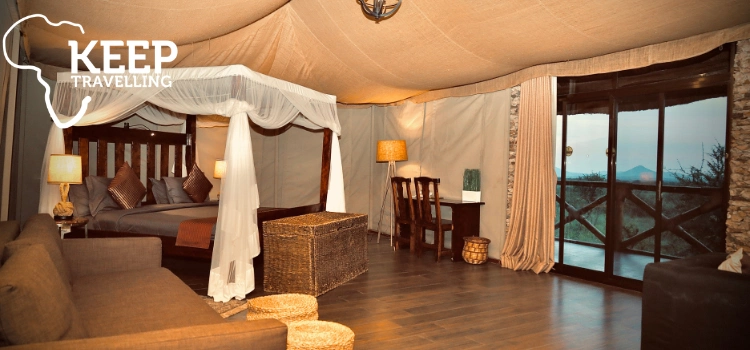
Serengeti Safari Lodge is a luxury tented lodge set on a hill in central Serengeti.
That hilltop setting gives the lodge a strong sense of place. Guests are not just staying near the Serengeti. They are staying within it, surrounded by views, space and wildlife.
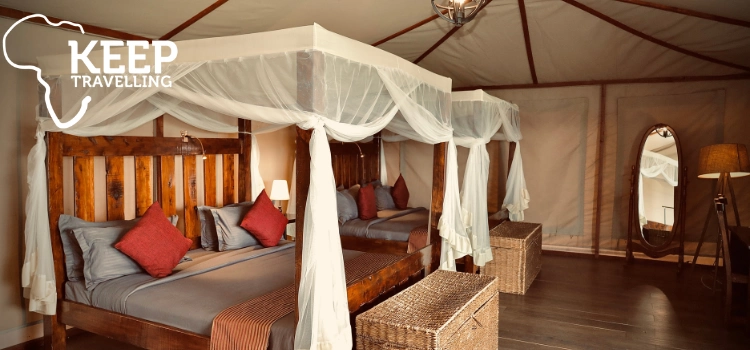
Nancy explained that the lodge has 22 rooms. These can work for different travellers, including single guests, couples, families and small groups. Room setups can include single beds, double beds, triple beds and family options.
That flexibility helps because safari travellers do not all arrive in the same shape. Some come as couples. Others arrive as families, friends or solo travellers. A good safari lodge needs to understand that.
The lodge has a large lounge area and a reception area where guests receive briefings and meet the team. This matters because a safari lodge should make guests feel comfortable from the start. You are not checking into a city hotel. You are entering a wild environment, and good information helps you relax.
One of the strong details Nancy shared was the personal butler service. Guests are assigned a butler who helps with luggage, escorts them to their rooms, takes note of requests, checks dietary needs and helps them understand the lodge.
This kind of service can change the whole mood of a stay.
It is not about being overly formal. The point is to feel looked after. After long travel, that matters. After a day in the bush, it matters too.
Rooms at Serengeti Safari Lodge
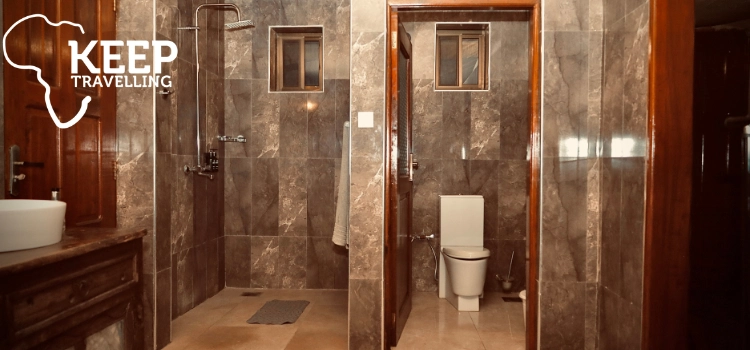
The rooms at Serengeti Safari Lodge are en-suite and include private bathrooms. Nancy also mentioned bathtubs, outdoor showers and balconies.
That mix of comfort and outdoor feeling is one of the joys of a luxury tented safari lodge.
Travellers can enjoy the wild setting without giving up the comforts that make a holiday feel easy. A private bathroom, a proper bath, an outdoor shower and a balcony all help guests settle into the rhythm of safari.
The balcony detail stood out.
Nancy explained that guests can sometimes see animals from their rooms, especially early in the morning. That is exactly the sort of moment many travellers remember years later.
It is not always the loudest moment that stays with you. Sometimes it is not even the most dramatic sighting. A quiet morning view from the balcony before the day has fully begun can be just as powerful.
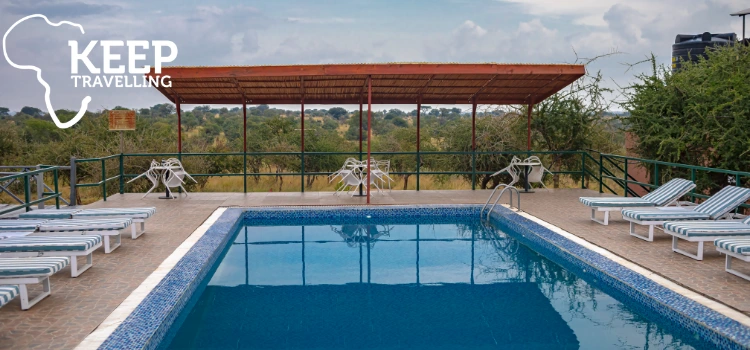
There is also a large swimming pool area where guests can watch the sunset. After a hot game drive, that can feel like gold. You return from the dust, the light, the animal sightings and the long tracks, then cool down as the sky starts to change.
The lodge also has a bar, which gives friends and families a place to sit together, talk about the day, and enjoy the slow end of a safari afternoon.

Food at Serengeti Safari Lodge
Food can make or break a stay, especially on safari.
Travellers often worry about what they will eat, whether their dietary needs can be handled, and whether there will be enough variety during a multi-night stay.
Nancy was clear on this. Serengeti Safari Lodge asks about guest requests, allergies and dietary needs so the team can prepare.
She explained that the lodge caters for different types of meals. Breakfast often follows an English-style format because it works well for international guests, while buffet options allow people to choose what suits them.
This buffet approach can be very useful on safari. One guest may want vegetarian food. Another may prefer chicken or fish. Someone else may be looking for red meat, vegetables or curries. A buffet gives choice without making the meal feel complicated.
Nancy also mentioned barbecues and a wide range of dishes.
Rael asked her directly whether anyone would leave the lodge hungry. Her answer was simple.
Nobody.
That sort of confidence says a lot about the hospitality mindset. A safari day starts early, runs on energy, and often includes long hours outside. Guests need good food, and they need to feel cared for.
Serengeti Safari Lodge seems to understand that.
Game Drives in the Serengeti
In central Serengeti, the main safari activity is game drives.
Nancy explained that walking safaris are not offered at Serengeti Safari Lodge because of the wildlife in that area. Central Serengeti is prime wildlife country, so safety comes first.
She also explained that walking alone around the lodge, especially early in the morning or in the evening, is not advised.
This is a small but important point.
Luxury does not remove the wildness of the place. Guests may have a beautiful room, a butler, a pool and a bar, but they are still in big wildlife country. That is part of the thrill, and it also demands respect.
The Serengeti landscape includes open savanna, short grasses, acacias, shrubs and bushes. Different areas support different animals, which is why game drives need time.
You may see wildebeest and zebra easily. Giraffe, hippo and antelope may also appear, and buffalo are often found too. For a better chance of seeing predators or more elusive animals, you need time in the vehicle, time in the area and a guide who understands the land.
Why Three Nights Works Best
Nancy recommends at least three nights at Serengeti Safari Lodge.
This was one of the most useful parts of the conversation.
Many travellers try to do too much in too little time. They want to see every park, every animal and every famous place. The problem is that they can end up rushing through the safari instead of really feeling it.
Nancy explained why three nights works better.
On one day, guests could enjoy a balloon safari early in the morning, followed by brunch. After that, they can enjoy a slower game drive back to the lodge, then relax by the pool, have drinks and take in the view.
The next day could focus on one side of the Serengeti where the short savanna makes it easier to spot certain animals, including cheetah and smaller creatures.
Another day could take guests toward the rocky areas where lions may be found, and where leopards may also move.
That sort of pacing makes sense.
The Serengeti is huge. You cannot understand it in one quick drive. The experience needs space, and the landscape needs time to unfold.
Nancy made a very good point. Travellers spend a lot of money to reach a place like this, so they should give themselves enough time to enjoy it properly.
That is honest advice, and it is good advice.
A Serengeti safari should not feel like a race.
The Magic of a Balloon Safari
A hot air balloon safari over the Serengeti is one of those experiences that sounds almost unreal until you picture it properly.
Early morning. Cool air. Soft light. The land below you. Animals beginning their day.
Nancy explained that animals are very active in the early hours. Predators may hunt. Hippos may move back toward water after feeding. Across the bush, everything starts to wake up.
From a balloon, guests can see areas that vehicles do not always reach. They can look down over the savanna and watch the Serengeti from a completely different angle.
That is what makes it special.
A game drive places you inside the land. A balloon safari lifts you above it. Both experiences tell a different story.
Nancy described it as a lifetime experience, and it is easy to understand why. A balloon safari is not only about spotting animals. It is also about scale. From above, you see how big the Serengeti really is.
For travellers who can include it, the balloon safari can become one of the defining memories of the trip.
When to Visit the Serengeti
Seasonality matters in the Serengeti.
Nancy explained that the high season brings more visitors. During this time, guests may see more vehicles on game drives, especially in popular areas. That is normal in famous safari regions.
During low season, there are fewer people and fewer vehicles, which can make the experience feel quieter and more private. However, Nancy also pointed out that animals can sometimes be harder to spot during low season.
So, the best time depends on what matters most to you.
Do you want stronger wildlife visibility? Would you rather have fewer vehicles? Are green landscapes important to you? Or are you looking for a good balance between wildlife viewing and space?
Nancy suggested that June can be a lovely time, especially from early June into early July. This period sits at the end of the rainy season and before the full peak season begins in July.
The land can still look green, the season starts to shift, and travellers may find a good balance between wildlife viewing and space.
That kind of advice is useful because it does not pretend that one month suits everyone. Instead, it helps travellers think more carefully about timing.
The Southern Circuit
Although the northern circuit receives much of the attention, Nancy also spoke about Tanzania’s Southern Circuit.
For travellers who want to move away from the more famous areas, she suggested looking at places such as Nyerere National Park, Selous and Mikumi National Park.
These areas offer wildlife, beautiful accommodation and fewer visitors.
This is important because not every traveller wants the same safari. Some people dream of the Serengeti, and rightly so. Others want quieter corners, remote spaces and less vehicle traffic.
Tanzania can offer both.
The northern circuit gives travellers access to iconic destinations like Serengeti, Ngorongoro, Tarangire and Lake Manyara. By contrast, the Southern Circuit gives a different style of safari, often with more space and a stronger feeling of being away from the crowd.
A well-planned Tanzania safari can match the traveller to the right circuit.
That is where good advice matters.
Africa Is More Than Wildlife
One of the strongest parts of the episode came when Rael asked Nancy what she would say to people who feel nervous about travelling to Africa.
Nancy answered with warmth and pride.
She said Africa is beautiful. Not only because of the wildlife, but because of the people, hospitality, food and culture.
That is a message worth repeating.
Many travellers still arrive with ideas shaped by what they have seen on the news or heard from people who have never been. They may imagine Africa as difficult, unsafe or unknown.
Of course, any journey needs good planning. That is true anywhere in the world. Nancy’s point, though, was clear. There is more to Africa than what people often hear.
Africa is welcome. It is generosity. It is conversation, flavour, rhythm, landscape and community. Across the continent, travellers also find professional hospitality, strong lodges, skilled guides and people who love sharing their home with visitors.
Safari may bring travellers to Tanzania, but the people often bring them back.
Conservation and the Future of Tanzania Tourism
Rael also asked Nancy whether Tanzania is doing enough to grow tourism in a way that protects it for future generations.
Nancy spoke about conservation initiatives from government and private institutions. She mentioned the importance of educating tour guides, hotel owners and visitors about how to care for national parks.
Practical steps matter too. Nancy spoke about managing roads in certain areas so the land can recover, as well as using solar power in camps to avoid putting electrical lines through national parks.
These details matter.
Sustainable tourism is not only a phrase for brochures. It has to show up in daily choices. How camps use power. How roads get managed. How guides behave. How guests move through sensitive areas. How private companies and government work together.
Tanzania’s tourism future depends on protecting the very places travellers come to see.
Wildlife, land, communities and the quality of the guest experience all connect.
If the Serengeti loses its wildness, everyone loses. If tourism grows without care, the destination becomes weaker. With thought, education and respect, however, tourism can support conservation and livelihoods at the same time.
Nancy’s Passion for Tourism
Nancy’s own love for tourism came through strongly in the final part of the conversation.
She said she loves the tourism industry and can see herself continuing with Tanzania Wild Camps, telling people about the beauty of Tanzania and hosting guests.
That word “hosting” matters.
Good tourism is not only about selling rooms or booking trips. It is about hosting people properly. Guests need to feel welcome, safe, informed and excited. They also need space to experience a destination with care.
Nancy clearly takes pride in that.
Her energy in the episode was warm and open, and her message was simple: Tanzania has beautiful things to share.
Why Serengeti Safari Lodge Suits Luxury Safari Travellers
Serengeti Safari Lodge works well because it brings together several important things.
First, it has a strong location in central Serengeti. That gives guests access to one of Africa’s most famous wildlife areas.
Second, it sits close to the airstrip, which makes arrival easier for travellers who choose to fly in.
Third, it offers comfort without removing the safari feeling. Luxury tented rooms, en-suite bathrooms, outdoor showers, balconies, a pool, a bar and butler service all help guests relax.
Fourth, it gives travellers access to game drives and balloon safaris, while still allowing time to enjoy the lodge itself.
Finally, it encourages a better pace. Nancy’s advice to stay at least three nights is not a throwaway line. It is the key to enjoying the Serengeti properly.
A rushed Serengeti safari may still be beautiful, but a well-paced one gives the land time to speak.
Final Thoughts
This episode with Nancy Ngotea offered a clear and useful look at Serengeti Safari Lodge and the wider Tanzania safari experience.
For first-time safari travellers, the conversation gave practical advice about airports, access, game drives, wildlife and how long to stay. For those who already know Africa, it offered a warm reminder of why Tanzania remains so special.
The Serengeti has a way of holding people in its grip. Maybe it is the endless grass. Maybe it is the animals. Perhaps it is the morning light, the dust, the silence between sightings, or the sound of life moving beyond your room at night.
Or maybe, as Nancy suggested, it is all of it together.
The wildlife, yes.
But also the people. The food. The culture. The hospitality. The welcome.
That is what makes a Tanzania safari more than a holiday. It becomes a story you carry.
A few years from now, you will not remember how much it cost you, but you will always remember the memories you made. Keep Travelling.