In the latest episode of ‘Keep Travelling: Your African Story’, host Rael Zieve sat down with Kristina Plattner, Managing Director of Kamba African Rainforest Experiences, to explore a Congo rainforest safari that feels very different from Africa many travellers know.
This is not the usual story of open plains, dusty tracks, lions on the horizon, and sundowners beside a game vehicle. It is quieter. Wetter. Deeper. More secretive. Kamba takes guests into the Republic of the Congo, into the Congo Basin, and into Odzala-Kokoua National Park, where the forest is not just the background to the journey. It is the journey itself.
For travellers who have done the classic safari circuit and now want something rarer, Kamba offers a different kind of African wilderness. It is about western lowland gorillas, forest elephants, rivers, walking, kayaking, birds, butterflies, insects, and learning to slow down inside one of the world’s great rainforests.

Where Kamba Africa is found
Kamba African Rainforest Experiences is based in the Republic of the Congo, not the Democratic Republic of Congo. That distinction matters, because the two countries sit on opposite sides of the Congo River, with different governments, different histories, and different travel routes.
Kristina explained that Kamba is based in the Congo Basin, the second largest rainforest on the planet after the Amazon. That makes this journey stand apart. Many international travellers know Africa for savanna, desert, coast, mountain, and bushveld. Yet Africa also has vast rainforest, and Kamba brings that world into focus in a way that feels personal, guided, and properly looked after.
Most guests travel first to Brazzaville, the capital of the Republic of the Congo. There are flight connections from Paris, Addis Ababa, and Johannesburg, which makes the journey more accessible than many people first imagine. Still, Kamba understands that the word Congo can make some guests nervous. So the guest experience starts before the forest. The team meets travellers at immigration, helps with luggage, assists with the transfer into Brazzaville, and then manages the onward journey to the park.
That level of support matters. A Republic of Congo safari is not a casual add-on where guests work everything out alone. Kamba makes a remote destination feel possible and smooth, while still keeping the adventure alive.
From Brazzaville to the rainforest
The journey from Brazzaville to the camps is part of the story. Kamba operates a charter flight every Monday and Thursday, taking guests from Brazzaville to the park in around one hour and forty-five minutes to two hours. The plane lands on a grass strip inside the park, where guides and lodge staff take over.
Most guests do not simply visit one lodge. Kamba usually offers seven, ten, and eleven-night trips, with guests experiencing all three camps during one journey. This matters because the rainforest is not one single thing. Each area has its own pace, mood, wildlife, and way of revealing itself.
Kristina’s favourite is Lango Lodge, the second lodge in the circuit. And the reason is easy to understand. Lango sits beside a bai, which is a natural clearing in the rainforest created by elephants. These clearings form where mineral-rich water draws elephants to dig for salts, helping them replace electrolytes. Over time, their movement opens the forest and creates a space that attracts other wildlife.
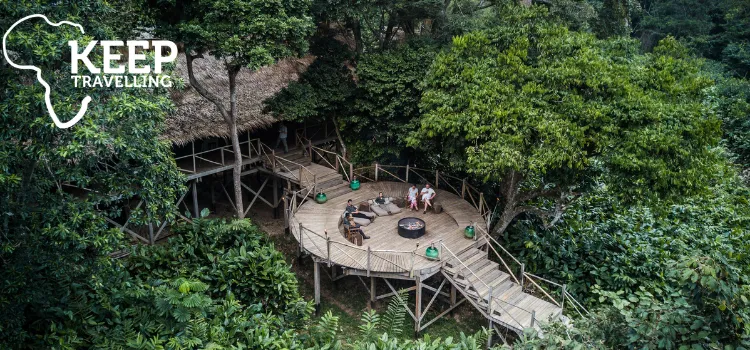
That means Lango is not simply placed in a beautiful location. It sits on the edge of an active wildlife stage. Buffalo, bongo, forest hogs, African grey parrots, elephants, and other animals all use the clearing. Guests can sit on the deck and watch life unfold.

Arriving at Lango Lodge
One of the loveliest parts of the episode is Kristina’s correction when Rael says, “I’ve landed in Lango.” Because guests do not really land at Lango. They arrive.
And that arrival is an experience in itself.
Guests are driven to a small jetty, where they get into kayaks and paddle down the Likoli River. The journey usually takes around an hour to an hour and a half, depending on water levels and river flow. There are no rapids. It is downstream and gentle, but it is still deeply atmospheric.
At a certain point, when the river becomes too shallow, the kayaks are left behind and guests continue on foot through the rainforest. That final walk is often the first proper wet forest walk of the journey. Guests may already come across buffalo, elephants, tracks, sounds, and the heavy breath of the forest before they even reach the lodge.
That is the essence of Kamba. The lodge is not separated from the wilderness. The wilderness begins before you unpack.
At Lango Lodge, comfort is present, but it does not shout. Rooms have comfortable double beds, feather duvets, hot and cold showers, fans, natural airflow, and views into the surrounding forest. The rooms are open-sided with fine mesh, so guests can hear the forest all the time. There are no hairdryers, and it is not trying to be a city-style luxury hotel dropped into the jungle. Instead, it offers the comfort you need after a day of walking, kayaking, listening, and watching.
The food is another part of the experience. Kristina explained that guests often praise the kitchen, which combines Congolese ingredients with French and international influences. So there is familiarity, but also a local twist. You are far from home, but still looked after.
What makes a Congo rainforest safari different
A Congo rainforest safari asks guests to change their rhythm.
On a classic safari, the landscape is often wide open. You may see animals from far away. You scan the horizon. You stop, look, photograph, and move again. In the rainforest, everything becomes more hidden. The forest is thick. The sounds matter. The small things matter. The guide matters. Patience matters.
Kristina said that in the Congo, you can walk past an elephant within thirty or forty metres and not even know it is there. That gives a good sense of the environment. This is not a place where wildlife always presents itself neatly. You enter quietly. You listen. You become aware of what is close, what has passed, and what may still be watching from the green wall around you.
Western lowland gorillas are a major reason guests come to Kamba, and they are a powerful draw. Yet the episode makes clear that the gorillas are only one part of the whole story. Forest elephants, buffalo, bongo, forest hogs, hyenas, smaller monkeys, antelope, African grey parrots, green pigeons, butterflies, insects, and even head-banging termites all help shape the experience.
That is where this kind of safari becomes special. It is not only about the biggest animal or the cleanest photograph. It is about learning to notice. A pink praying mantis can become as memorable as a large mammal. A butterfly migration can make the forest feel like something from a storybook. A night scope watching elephants at the bai can stay with you for years.

Lango’s bai and the life around it
The bai at Lango is one of the strongest images from the conversation. In simple terms, a bai is a clearing. But in reality, it is much more than that. It is a meeting place, a mineral source, a feeding area, and a window into a forest that is often hard to read.
Elephants help create these openings. They come to dig for salts and minerals, and over time the forest opens. Then other animals follow. This creates a rare chance for guests to observe rainforest wildlife from the lodge deck or on guided walks.
Lango sits carefully on the edge, between the forest and the clearing. That positioning matters. It allows guests to feel close without taking over the space. The lodge does not dominate the bai. It watches from the side. And that restraint is part of the charm.
During the day, the bai may feel calm. At night, elephants often come out. With a night scope, guests can watch them play, feed, and move through the clearing. This is a very different feeling from driving up to an elephant on a road. As Kristina said, there is a big difference between driving past an elephant and walking past one on foot.
That closeness changes the emotional weight of the encounter. It makes you quieter.
Walking, kayaking, boating, and listening
Kamba’s activities are built around immersion. Guests walk, kayak, boat, track, watch, and listen. Many activities are on foot, and that is one reason children under fifteen are not accepted. Gorilla tracking follows IUCN protocols, and walking in the forest requires guests to listen carefully to guides and stay calm for long periods.
The walking is not described as extreme hiking. Guests need a reasonable level of fitness, and Kamba asks for a medical form before travel, mostly because of the walking and remote setting. Kristina mentioned that guests with knee and hip replacements have visited, and that their oldest gorilla trek participant was eighty-six. So it is not only for super-athletes. However, it is for people who can move comfortably, follow instructions, and respect the environment.
Kayaking is another beautiful part of the Lango experience. Guides manage safety carefully, especially because hippos and crocodiles do live in the waterways. Kamba uses two guides on kayak trips, with one guide going ahead to check the route. If there is any potential danger in the water, guests can stop, walk on shore, and re-enter later.
The crocodile population includes slender-snouted crocodiles, which are smaller and often seen resting on fallen trees beside the river. Nile crocodiles are present too, although Kristina described sightings as occasional. Again, the message is not fear. It is respect, awareness, and good guiding.
The best time to visit Kamba
Kamba is open all year, which is helpful because the best time to travel depends on the kind of experience guests want.
The drier seasons are generally June to September and December to February. The wetter seasons are March to May and late September to November. Yet because this is rainforest, guests should expect to get wet at some point. Rain may fall from above, and walking through water is part of the experience too.
The wetter season brings higher rivers. That can make boating and kayaking more adventurous, allowing guests to reach certain forest clearings that may not be accessible when water levels drop. It can also mean slightly less walking into Lango.
During drier periods, rivers narrow and water levels fall. Guests may walk more, and animals may come to drink from the river more often because there are fewer water sources in the forest. That can create different wildlife encounters.
Then there are the changeover periods, when butterfly migrations may pass through. Kristina described blue, pink, yellow, and white butterflies moving through the forest, creating a magical scene. It is a lovely reminder that this destination is not only about big-ticket wildlife. The small seasonal moments can be just as powerful.
In many ways, Kamba is not a one-time, one-season destination. Kristina said more guests are beginning to return at different times of year because each visit feels different. That says a lot about the depth of the place.
Why choose Kamba after a classic safari
Kamba is probably best suited to travellers who have already experienced Africa and want to go deeper.
That does not mean first-time visitors cannot enjoy it. But the experience will likely speak most strongly to people who have done the open plains, seen the classic safari landscapes, and now want something less familiar.
Kristina put it clearly. Kamba is for someone who wants to get away from the mainstream. It is remote, quiet, and small, with a maximum of twelve guests per camp. That small group size helps protect the feel of the place. There is no sense of crowds or safari traffic. Instead, guests become part of the forest rhythm.
Many people arrive thinking the gorillas will be the highlight. By the end, they often say they cannot choose one favourite moment. It may be the gorillas, but it may also be meeting elephants on foot, taking early boat rides, sitting quietly at the lodge, or hearing the forest come alive around them.
That is the strength of a Congo rainforest safari. It does not depend on one single moment. It builds slowly. It gets under the skin.

Practical travel details
Kamba’s packages are designed to make the journey easier. The quoted experience usually includes a night in Brazzaville, charter flights to camp, accommodation, food, drinks apart from premium drinks, gorilla tracking permits, guided walks, transfers, and internal logistics. Guests, or their tour operator, book the international flights to Brazzaville separately.
Visa support is also part of the process. Kristina explained that Kamba can help arrange visas on arrival when guests provide passports and flight itineraries around four to six weeks before travel. This removes the need for many guests to visit a Congolese embassy in their home country.
There is a compulsory yellow fever vaccine requirement, which is checked at the border. Kamba also recommends malaria prophylaxis. As always, travellers should speak to their own travel clinic or doctor before departure, but the important point is that Kamba provides clear pre-travel guidance.
The all-inclusive structure matters because there are no outside restaurants once guests are in the park. Kamba handles the moving parts so guests can focus on the experience.
A future story with Glance Eloy Nzutani
The conversation also pointed towards a future episode with Glance Eloy Nzutani, Kamba Africa’s first trained wilderness guide. Kristina spoke warmly about his journey and the way he is helping bring more Congolese guides into the guiding team.
That is part of the wider story. Guests do not only travel to see landscapes and wildlife. They also come to meet people, hear local voices, and see how tourism can support skills, pride, and opportunity.
For African tourism to grow well, local guiding matters. It brings knowledge, culture, confidence, and authenticity into the guest experience. So the mention of Glance was not a small side note. It was a sign of where Kamba is going, and why the human story behind the lodge matters just as much as the forest itself.
A safari that asks you to slow down
Kamba African Rainforest Experiences offers something rare in African travel. It asks guests to slow down, listen harder, and stop expecting the wilderness to perform on command.
There are gorillas, yes. There are forest elephants, buffalo, parrots, hyenas, butterflies, crocodiles, river journeys, wet walks, and deep forest moments. But the real beauty of Kamba sits in the way all those pieces come together.
It is the kayak arrival. The forest sound through the mesh of your room. The bai at night. The guide asking you to pause. The butterflies passing through. The feeling of being far from the usual safari circuit. The thought that Africa still has places many travellers barely know exist.
For those looking for a Republic of Congo safari that feels immersive, intelligent, and deeply different, Kamba deserves serious attention. Not because it tries to copy the classic safari experience, but because it does not.
A few years from now, you will not remember how much it cost you, but you will always remember the memories you made. Keep Travelling.
For African travel planning and enquiries, contact rael@keeptravelling.africa